Performance-Critical Web Development

    Precision Web: Web Development for the AI Era

    Most websites are slow, technically messy and invisible to AI. Precision Web is our approach to fixing that — with React and Next.js, real Core Web Vitals results and structure that helps ChatGPT, Gemini, Claude, Perplexity and Copilot actually understand what you do.

    This service is designed for businesses where performance and technical precision are business-critical—not cosmetic. The website is infrastructure, not just a calling card.

    TL;DR

    Short version: we build websites that load in under a second, score 95–100 on Lighthouse and are structured so AI models can cite you. Not magic — just proper technical craft.

    The Lighthouse Proof

    BEFORE
    49
    Perf
    62
    A11y
    58
    BP
    65
    SEO

    Typical WordPress/template-based website with heavy plugins and poor structure.

    AFTER
    digitalthinking.no
    97
    Performance
    100
    Accessibility
    100
    Best Practices
    100
    SEO
    Core Web Vitals
    LCP0.8s
    CLS0.00
    INP42ms
    FCP0.4s
    Tech stack
    ⚡ Next.jsReactTypeScriptTailwind CSSVercelStructured data
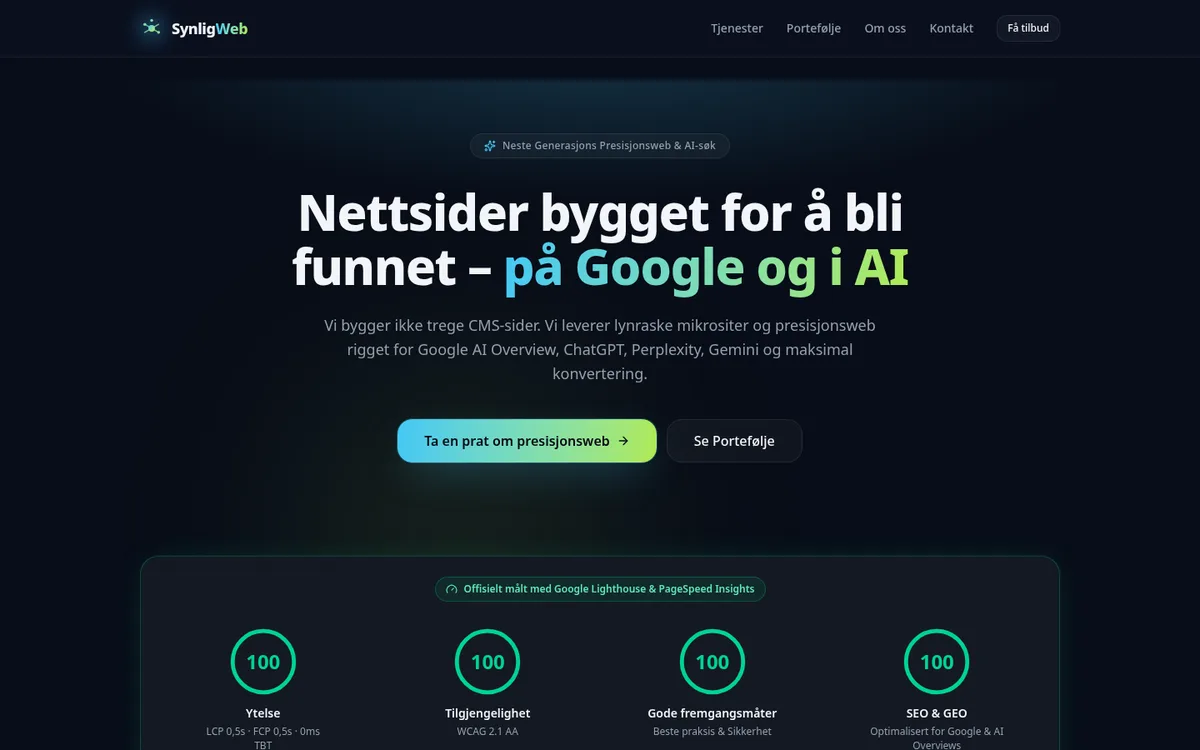
    Lighthouse 97–100 — built by Digital Thinking's own team in React and Next.js

    We don't just deliver a design — we deliver infrastructure that performs. Our standard is a perfect score on Performance, Accessibility, Best Practices and SEO.

    Free Precision Audit

    We perform a manual analysis of your website's technical health and citation share in AI engines. You receive a concrete report on why you are winning or losing against competitors in AI answer boxes.

    What is High-Performance Web?

    Precision Web is really just a name for what we think web development should always have been: fast, technically clean and built to be understood — not just seen. We build it ourselves, in React and Next.js, and we measure the result with real numbers.

    • Technical focus: performance, architecture, and control over visual polish
    • Use cases: business-critical websites, landing pages with conversion goals, platforms with high scalability requirements
    • Expected outcomes: LCP < 2.5s, CLS < 0.10, INP < 200ms, Lighthouse 95+ on mobile
    • Delivery: verified with before/after report, change log, and documented improvements
    • Tools: React, Next.js, Vite, Tailwind, TypeScript, edge hosting

    The result is a website that loads fast, renders stably, and is structured to be understood by both search engines and AI systems.

    What High-Performance Web is not

    We get quite a few enquiries that aren't a good fit. Better to be upfront about it:

    • Not traditional web design: High-performance web is about technical performance, not visual design.
    • Not standard WordPress development: We don't build on heavy CMSs with plugin dependencies.
    • Not template-based CMS solutions: Templates rarely provide the control required for optimal performance.
    • Not marketing-focused landing pages: We build for technical performance and AI readability, not campaigns.

    High-performance web is a technical delivery model, not a design service.

    The difference between High-Performance Web and traditional web development

    High-Performance WebTraditional Web Development
    ArchitectureComponent-based, headless, edge-firstMonolithic CMS, server-based
    AI Visibility (GEO)Fully optimized with llms.txt and SchemaNo structure for AI crawlers
    Performance (Core Web Vitals)Guaranteed 90–100 Lighthouse scoreVariable (often 40–70)
    Conversion PowerHigh (fast load time lowers bounce rate)Medium/Low
    FlexibilityFull control over structure and renderingLimited by theme/plugins
    ScalabilityBuilt for growth, edge hostingServer load increases with traffic
    Long-term TCOLow (fewer technical issues, higher conversion)Variable (often higher maintenance)
    Time-to-valueHigh (faster indexing and visibility)Medium
    When it fitsBusiness-critical platformsSimple websites with low traffic

    When should you choose High-Performance Web?

    High-performance web fits situations where:

    The website is business-critical

    Downtime or slow loading has direct consequences for revenue or reputation.

    Load time affects conversion

    Each extra second increases bounce rate and reduces sales.

    SEO and GEO depend on performance

    Google and AI systems prioritize fast, structured pages.

    Standard tools become a limitation

    Templates and plugins don't provide the control you need.

    You need AI-readable structure

    AI search engines cite pages with clear, semantic structure.

    When should you not choose High-Performance Web?

    High-performance web is not always the right choice. Consider simpler solutions if:

    • You need a simple informational site without conversion goals
    • Budget doesn't allow for technical optimization
    • The website is not business-critical
    • You prefer to edit content yourself in a visual CMS

    We're not keen on taking every job either. A bad match wastes both our time.

    How Digital Thinking works with High-Performance Web

    From analysis to continuous improvement

    🔍1
    Analysis
    Lighthouse, Core Web Vitals and technical audit
    🏗️2
    Architecture
    Next.js structure, routing and data flow
    3
    Development
    React components and content structure
    🎯4
    Optimization
    Core Web Vitals, SEO and GEO readiness
    🛡️5
    Maintenance
    Continuous updates and improvements
    📋 Deliverable
    Technical report
    Priority list
    Lighthouse baseline
    📋 Deliverable
    Next.js setup
    Component library
    Design tokens
    📋 Deliverable
    Working website
    Responsive design
    CMS integration
    📋 Deliverable
    97–100 Lighthouse
    Structured data
    GEO-ready
    📋 Deliverable
    Monthly report
    Technical support
    Further development

    Acceptance Criteria

    • LCP: < 2.5s on mobile for primary pages, optimized hero/LCP element and resource priority.
    • CLS: < 0.10, all images/icons are sized, stable navbar height.
    • INP: < 200ms, reduced JS cost and removed blockers.
    • SEO: Correct title/meta, canonical links, crawlable internal structure.
    • AI readiness: Definition-first paragraphs + semantic structure for citability.

    What you get

    Concrete deliverables with measurable impact

    Baseline + measurement plan

    Lighthouse + Core Web Vitals setup and baseline before changes.

    LCP optimization

    Hero/LCP actions, image priority, and critical rendering improvements.

    CLS stability

    Sized assets/aspect ratios, stable containers, no layout shifts.

    INP/JS control

    Reduced JS cost, faster interaction, removed blockers.

    Technical SEO

    Structure, metadata, internal linking, index-ready pages.

    Verification

    Before/after report with measurements, change log, and documented impact.

    Our Tech Stack

    Modern tools for modern challenges

    ReactNext.jsViteTailwind CSSTypeScriptSupabaseVercel Edge

    Frequently asked questions about High-Performance Web

    Key Terms in High-Performance Web

    Headless CMS
    A content management system where the frontend and backend are decoupled, giving full control over the presentation layer and better performance.
    PWA (Progressive Web App)
    A web application using modern web technologies to deliver app-like experiences, including offline support and home screen installation.
    Core Web Vitals (LCP, CLS, INP)
    Google's three key user experience metrics: LCP measures loading time, CLS measures visual stability, and INP measures interaction responsiveness.
    Semantic HTML
    Using HTML elements that describe the meaning of content (like <article>, <nav>, <section>) rather than just visual structure, improving accessibility and machine readability.
    Structured Data (Schema)
    A standardized format (JSON-LD) for describing web page content so search engines and AI systems can understand and present the information correctly.

    Need a website that actually performs?

    Book a free tech audit and get a detailed report on how we can improve your website's performance.

    Book Tech Audit